
Misplaced Faith

On July 1st, 2002, Arlin Ewald Nusbaum was called on a fast in the wilderness, and on July 4th, the Lord took him high above the Earth and showed him Earth’s inhabitants. Then he asked Arlin,
“Do you see the number of my followers?”
His followers appeared as tiny lights all over the world. Some areas had more than others, which was reflected by the concentration of light (or the lack thereof) that he could see, and he replied,
“Yes, I can see them Lord.”
He next said He would reveal to Arlin how many of them were watching and waiting for His return. He saw that the number of the lights he had seen before was greatly diminished. Jesus explained to Arlin that a fair number of those who are not looking for His return have misplaced their faith in Him, expecting and anticipating the arrival of the Antichrist instead.
He then gave Arlin Ewald the following commission.
“Tell My people (and all people) to put their faith in Me, and My coming glory, for it will come before the Antichrist.”
Apostle Paul
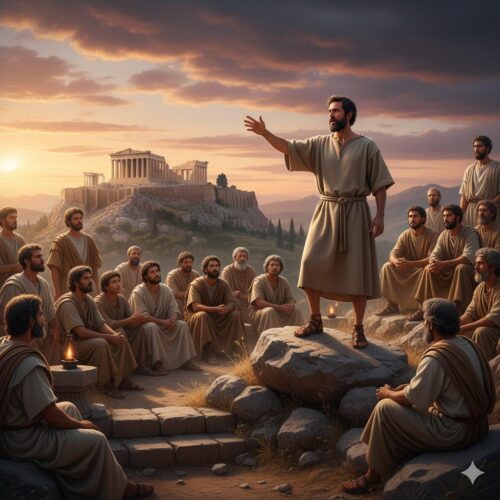
On October 30th, 2001, Arlin was visited by the apostle Paul, who was sent in response to prayers he had been sending up to God. Paul stayed with Arlin for 30 days and, during that time, took him through the scriptures regarding what “church” is and how he and others went beyond the scope of their callings by inventing things that had nothing to do with people’s salvation.
As Jesus said, “Ye have the poor always with you” (Mat 26:11). We don’t need the church to hijack, duplicate, or replace community-based programs or create church officers for them (e.g., deacons). The parable of the Good Samaritan demonstrates individuals taking the initiative.
The way “church” is done today is not based on Jesus’ teachings; that’s why Christians are divided, they each do as they please with no one to hold them to account. Jesus did not say to build churches, and none of His apostles ever did, so why are we doing it today? There are hundreds of church teachings and practices invented by men and women that have no basis in the teachings of Jesus or in salvation.
Authority

One thing the following teachers affirmed to Arlin is that authority is inherent in Jesus’ name.
William Barclay
Authority is a central point for many denominations, and some believe they alone have it and therefore control who gets into Heaven. Arlin’s acceptance of such a belief system ended after a visit by the late William Barclay (1907-1978) on August 20, 1996. He clarified to Arlin that Old Testament prophets (and even Paul) received their authority directly through their experiences with God.
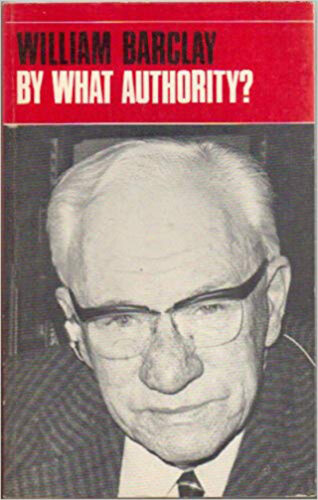
He was right, Paul did not seek authority or approval from the other apostles, and Jesus didn’t inform them that He had called Paul to be an apostle, which proves Jesus did not want or envision the Old Testament priesthood structure continuing with His followers. He fulfilled the law, and that system was no longer needed. William Barclay came to a clear understanding of authority and wants everyone to comprehend these truths.
John Calvin
John Calvin (1509–1564) also instructed Arlin for an even longer period, showing him where he lived, studied, wrote, and preached in Geneva, Switzerland. Calvin was tasked with replacing the Roman Catholic Church framework with something better after the citizens of Geneva banned the RCC.

Calvin’s non-priesthood-centric framework confirmed what Barclay said. Calvin went deep into every aspect of the Christian faith, grounded in the scriptures alone (Sola Scriptura).1 He had no intention of starting a new religion or denomination; that was done by others. He hoped, like Luther did, that the RCC would reform and fly right.
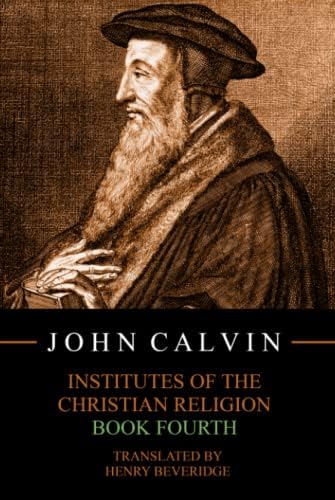
“Published first in 1536, the Institutes of the Christian Religion is John Calvin’s magnum opus. Extremely important for the Protestant Reformation, the Institutes has remained important for Protestant theology for almost five centuries. Written to “aid those who desire to be instructed in the doctrine of salvation,” the Institutes, which follows the ordering of the Apostle’s Creed, has four parts. The first part examines God the Father; the second part, the Son; the third part, the Holy Spirit; and the fourth part, the Church. Through these four parts, it explores both “knowledge of God” and “knowledge of ourselves” with profound theological insight, challenging and informing all the while. Thus, for either the recent convert or the long-time believer, for the inquisitive beginner or the serious scholar, John Calvin’s Institutes of the Christian Religion is a rewarding book worthy of study!”2
A fine quote regarding what “church” is:
“We know that the Holy Spirit calls all assemblies ‘church’ where the Word is preached, His name is purely declared, and the sacraments are administered” (John Calvin, A Compendium of the Institutes of the Christian Religion, Hugh T. Kerr, ed., Philadelphia: The Westminster Press, 1964, pp. 260).
Calvin wants the truths God taught him to spread throughout the world, without the church creeds and practices that he never taught. The person who did that most thoroughly was likewise sent to teach Arlin—Thomas Campbell (1763-1854).
Thomas Campbell
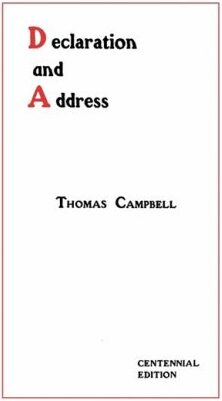
Thomas Campbell (1763-1854) taught Arlin that God had commissioned him to strip the church of non-Biblical teachings (he was a Presbyterian minister at the time) and that he published the results in his book, Declaration and Address, 1808. Campbell said an original copy was being held for him at a local bookstore under lock and key, and he would need to ask for it, which he did.
Arlin thoroughly consumed its contents and learned just how far Christianity had gone beyond what Our Lord had taught. People are making relationships with their churches, programs, worship groups, and figureheads at the expense of their relationship with God the Father and Our Lord Jesus Christ. We still do not yet have “One Lord, One faith, One baptism” (Eph. 4:5).
For a deeper dive into those experiences (and more), read:
Thomas L. Campbell

141 years later, another Campbell, Thomas L. (1915-2000), and Guy V. Caskey (1917-2003) compiled Why I Left (1949), which contains nine testimonies of ministers who left their denominations to more closely follow the Lord.
- Why I Left the Christian Church, Floyd A. Decker
- Why I Left the Presbyterian Church, Horace Busby
- Why I Left the Baptist Church, Grover Stevens
- Why I Left the Methodist Church, Claude B. Holcomb
- Why I Left the Nazarene Church, Waymon D. Miller
- Why I Left the Lutheran Church, Claude Guild
- Why I Left the World, Luther Blackmon
- Why I Left the Catholic Church, Joe Malone
- Why I Left the Anti-Class Position, L.W. Hayhurst
If our modern churches are not Biblical, what do we do? Arlin asked the Lord that question; this was His response, shared next.
The Joy-Filled Way

Instead of viewing the Good News as enshrined in an organization with a single leader at the top, we’re all equal in Christ, and the Good News should be expressed in how well we live it, not in how well we attend a man-centered, man-designed church organization. Here’s a taste from Arlin’s book.
Introduction
The Kingdom of God is JOY—Rom 14:17
With JOY we draw from the wells of SALVATION—Isa 12:3
Not that we be Lords over your faith, but are HELPERS of your JOY—2 Cor 1:24 BB
The JOY-Filled Way follows on the heels of 11 other titles, most of which dealt with divisions, misinformation, and apostasy in the body of Christ. Jesus said the love of many would wax cold in the last days because iniquity would abound due to an overabundance of false prophets and their false teachings within the body of Christ.
11 And many false prophets shall rise, and shall deceive many.
12 And because iniquity shall abound, the love of many shall wax cold. (Matthew 24)But that’s not all our Lord said. He said He would send forth the true Gospel (i.e., the Good News) to combat this coldness, and then the “end” would come.
14 And this gospel of the kingdom shall be preached in all the world for a witness unto all nations; and then shall the end come. (Matthew 24)
Isaiah also saw this day and described it as a “day of mourning” and added that the antidote is JOY.
3 To appoint unto them that mourn in Zion, to give unto them beauty for ashes, the oil of JOY for mourning, the garment of praise for the spirit of heaviness; that they might be called trees of righteousness, the planting of the Lord, that he might be glorified. (Isaiah 61)
The New Life Version translation of Isaiah 61:3 replaces “mourn” with “sorrow.”
3 To those who have SORROW in Zion I will give them a crown of beauty instead of ashes. I will give them the oil of JOY instead of SORROW, and a spirit of praise instead of a spirit of no hope. (Isaiah 61 NLV)
Sorrow may indeed be the better word, as mourning is most often associated with death. Which word best describes the state of a person who lacks JOY? Sadness. Look around you; are people in general—and Christians in particular—in a state of JOY or sadness? That’s a rhetorical question, of course. If Christians were in a state of JOY, they would not have let their petty differences divide them into more than 44,000 different denominations.
SUMMARY
Problem: Love of many waxes cold and people mourn / have sorrow.
Cause: False prophets, false teachers, and their false teachings.
Solution: Send the true Good News and JOY.
The Lord continued to unfold this new framework of Joy to Arlin, and he put every bit of it into that book. The “come to Jesus” dynamic is a necessary part of the Gospel, which is designed, overall, to secure our Joy forever, contrasted by those who will be left in Hell. It’s our right and privilege to have Joy in this life as well.
10 I am come that they might have LIFE, and that they might have it more ABUNDANTLY (John 10).
In reality, according to the Good News, ministers of the Gospel are meant to be Ministers of Joy (2 Cor 1:24 BB). The book goes deeply into the things that rob us of our Joy, plus very specific protocols for restoring and protecting it, making it a highly practical and very beneficial treatise given by the Lord Jesus, which He wants spread throughout the Earth.